Control-Bounded A/D Conversion
Analog-to-digital (A/D) conversion is an ubiquitous part of most of todays electronic devices as it interfaces the analog world we live in with the digital domain. Control-bounded A/D conversion is a type of A/D conversion that indirectly converts analog signals into their digital counterpart by stabilizing an analog system using digital control.
Conventional A/D Conversion
Traditionally, the A/D conversion process is divided into three steps, where we convert a given analog input signal \(u(t)\) into a digital estimate \(\hat{u}[k]\) by applying
an analog preconditioning (anti-aliasing) filter,
a sampler (sampling in time),
and a quantizer, i.e., mapping discrete-time samples into bits.

The three steps are additionally shown in the figure above, where we see the preconditioning, sampling, and quantization steps from left to right.
A new A/D interface
The control-bounded A/D conversion concept approaches this conversion process differently, as outlined in the figure below.
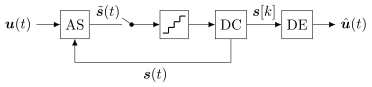
Specifically, the conversion process is divided into three main components.
The analog system (AS), preconditions the input signal by amplifying desired, while suppressing undesired, signal characteristics. Note that the AS is a fully analog system. Additionally, the A/D converter’s overall conversion performance is directly linked to the amount of amplification provided in this stage.
The digital control (DC) stabilizes the AS by observing a sampled and quantized version of the internal AS states and, based on these observations, provide a control signal \(\mathbf{s}[k]\) which is fed back into the AS (via a digital-to-analog (D/A) conversion step). The goal of DC is to (physically) bound the internal AS states. The DC ability to bound the AS states will directly affect the overall conversion performance. In contrast to the AS, the DC is a fully digital system, operating in synchronization with a global clock, with the exception of the control signal contribution \(\mathbf{s}(t)\) which is a continuous-time analog version of the control signal \(\mathbf{s}[k]\).
Finally, the digital estimator (DE) provides samples of a continuous-time estimate \(\hat{u}(t)\) given the control signal \(\mathbf{s}[k]\) and the knowledge of the general AS and DC parametrization. In many ways, the DE is the heart of the control-bounded A/D conversion scheme as it is able to produce estimates for essentially arbitrary AS and DC combinations. The internals of the DE might seem overwhelmingly complicated at first glance. After all, this is the result of many years of theoretical work (see references). However, the good news are:
For uniform samples, the DE reduces to a linear filter and can therefore be implemented with a complexity comparable to a \(\Delta\Sigma\) decimation filter.
cbadc.digital_estimatorimplements all the necessary computations and can, therefore, for a given AS and DC, provide you with the resulting filter coefficient of a DE.
In summary, the control-bounded A/D converter principle approaches A/D conversion unconventionally as, instead of breaking down the conversion into sampling and quantization steps, we focus on stabilizing an analog system using a digital control. In this view, conversion performance takes on a new shape as increasing the AS amplification in combination with a DC that enforces tighter control implies an increased A/D conversion performance. This results in a whole new analog design space with a considerable more unconstrained A/D interface, which in turn provides design opportunities for the analog designer.
Relation to \(\Delta\Sigma\) Modulators
But wait, the figure above looks like a continuous-time \(\Delta\Sigma\) modulator? Is it just the same?
Not quite. It is true that, in the scalar input, state vector, and control signal case, there is no difference between the AS and DC of the control-bounded architecture presented above and a first order continuous-time \(\Delta\Sigma\) modulator. However, the DE filter is derived in a conceptually different way compared to a decimation filer. Furthermore, for a general AS and DC the closest \(\Delta\Sigma\) concept is the MASH \(\Delta\Sigma\) modulator concept. However, the MASH concept requires a digital cancellation logic which fundamentally constrains how the AS and DC can be interconnected. In comparison, the control-bounded DE pose no such restrictions but instead enables a vast AS and DC design space.
Interestingly, any MASH converter can be written in the form of a control-bounded A/D converter and thereby benefit from using the simple design procedure of the DE as opposed to the conventional way of a digital cancellation logic followed by a decimation filter.
References
This was a brief introduction to the control-bounded A/D conversion concept. For a more in-depth description, consider the following references.
What’s next
Next follows a series of tutorials demonstrating common use cases of the cbadc package. In particular, consider the Getting Started.